
Within the Erasmus+ project “Digital Competences and Information Literacy for Librarians” (NEDLib), Work Package 4 is being implemented through local training activities organised by librarians in all five partner countries for colleagues and library users.
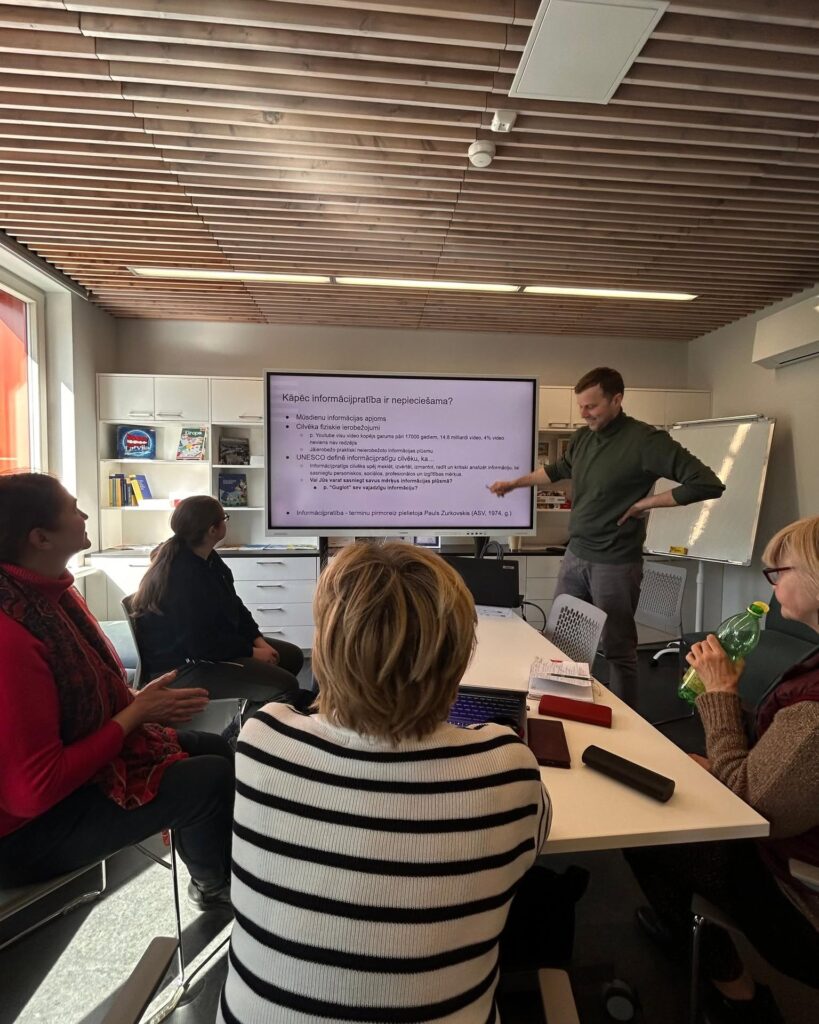
On 26 and 27 March 2026, a local training activity was held at Jūrmala Central Library, Latvia, with the participation of four learners.
The first day of the training was dedicated to information literacy and media literacy. The participants were introduced to methodological materials related to information, information needs and techniques for processing and evaluating information. In order to consolidate the knowledge gained, the participants worked with different information sources and, with the support of the librarian, classified them using the CRAAP and RADAR methods.
After the coffee break, the training continued with a focus on media literacy. Special attention was paid to the role of artificial intelligence in contemporary media, as well as its connection to the creation of fake news and the recognition of different forms of misleading content. The participants also tried to distinguish manipulated images and videos from authentic ones and classified various media examples according to their credibility. This activity led to a discussion on media ownership and the interests behind media content.
On the second day, the participants explored fake news, manipulation techniques and the role of language in shaping news formats. During the session, a discussion emerged on the difference between public relations and propaganda. The librarian guided the discussion and presented some of the most common manipulation techniques.
After the coffee break, the participants analysed news from different sources and tried to transform them into propaganda materials by applying one or more manipulation techniques. They also worked on recognising different types of manipulation.
At the end of the training, the participants discussed manipulation, media influence and fraudulent schemes. After the sessions, they expressed strong interest in future learning opportunities.
The training helped participants strengthen their competences in information literacy, media literacy, disinformation recognition and critical evaluation of digital and media content.